Use one reference across the operation
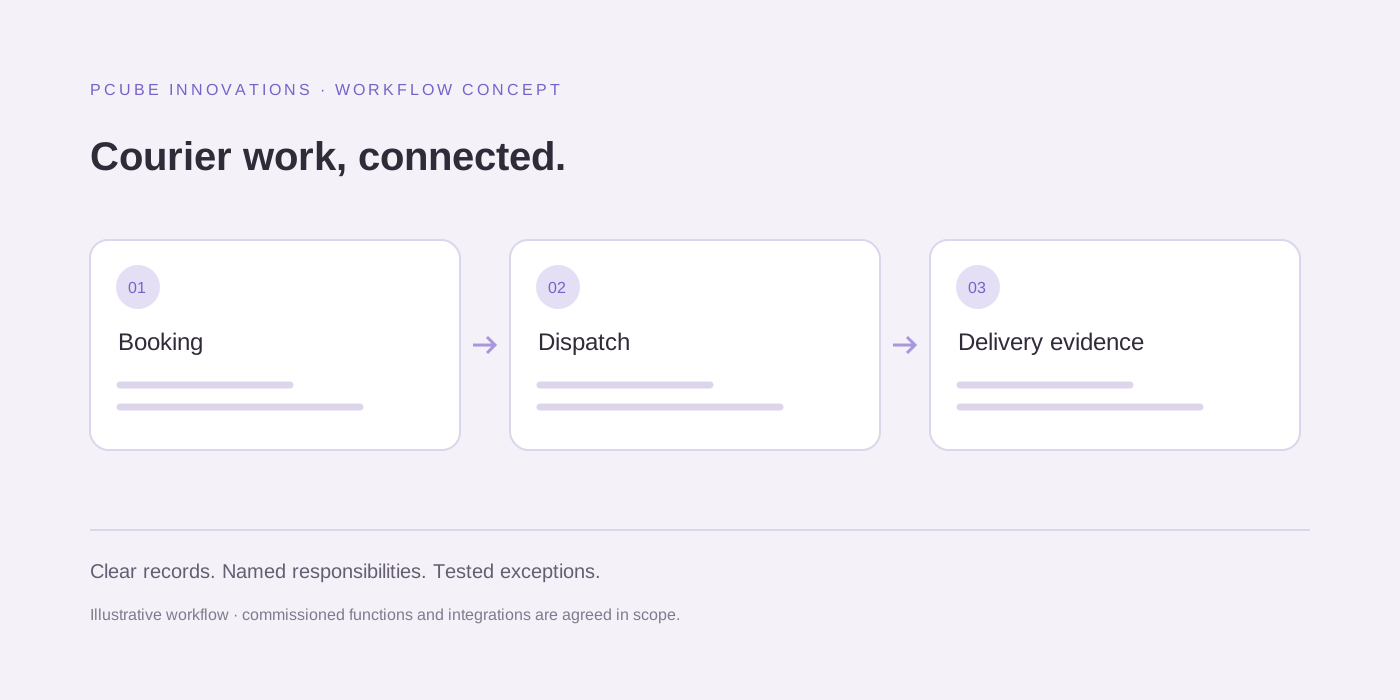
A booking should keep the agreed collection and delivery details with the parcel or job reference. Decide which fields staff must validate and what changes require a dispatcher’s review. The customer-facing reference and internal records need access controls, not just an easy-to-guess number.
Follow a parcel through assignment, collection, a failed attempt and completion. Make the outstanding action visible after each event. A status timeline is useful when it reflects authorised evidence rather than a prediction presented as a confirmed delivery.
Treat planned runs and same-day work differently
A planned delivery can use a scheduled run, booking cut-off and agreed stop rules. Same-day work may need capacity checks and reassignment during an active run. Write down how late bookings, missed collections and new destinations are handled before advertising those capabilities.
Route planning also needs the relevant constraints: vehicle limits, service times and permitted stops. A map display by itself does not establish an optimised or feasible route. If a routing provider is proposed, confirm access, charges and the inputs needed for a pilot.
Separate tracking milestones from live location
A parcel can have verified milestones without a continuous GPS feed. Live vehicle tracking needs compatible equipment or an authorised provider interface, together with a clear rule for stale or missing updates. Keep those states distinguishable to dispatch staff and customers.
Give staff a useful way to correct an incorrect scan or explain a failed delivery. Keep a reason and responsible user with the correction. Do not let the public tracking view reveal internal notes or another customer’s delivery details.
Test the operation under exceptions
Use representative bookings and ask for a demonstration of a driver reassignment, duplicate update, failed attempt and delayed integration message. Confirm which staff member receives the exception and how it returns to a normal workflow.
PCube can scope a courier booking-to-delivery system and assess supported integrations. The first release might focus on intake and dispatch, with tracking or a customer portal added after the underlying references and handovers are proven. An agreed pilot should decide the next step.
Useful questions
Can this guide help us prepare a software development brief?
Yes. Describe your users, records, operating rules, existing systems and exceptions, then use the worksheet to compare available products and a scoped development approach.
Does this guide establish the best product or a fixed market price?
No. This is an editorial decision framework, not a hands-on vendor benchmark or current price survey. Ask suppliers for comparable demonstrations and written quotations for your actual requirements.
Sources and further reading
Reuse and attribution
Reuse the original blank PCube workflow evaluation worksheet under CC BY 4.0 with attribution and a note of changes. Third-party documentation and provider content are excluded.
Suggested citation: PCube Innovations editorial. “Courier dispatch and tracking software: planned deliveries, same-day jobs and exceptions”. Updated 20 October 2026. https://pcubesolution.com/blog/courier-dispatch-tracking-software-guide.